HunchCheck — Is That Link Real?
A downloadable tool for Android
HunchCheck tells you whether a link in your own daily numbers is real, fragile, or just a pattern.
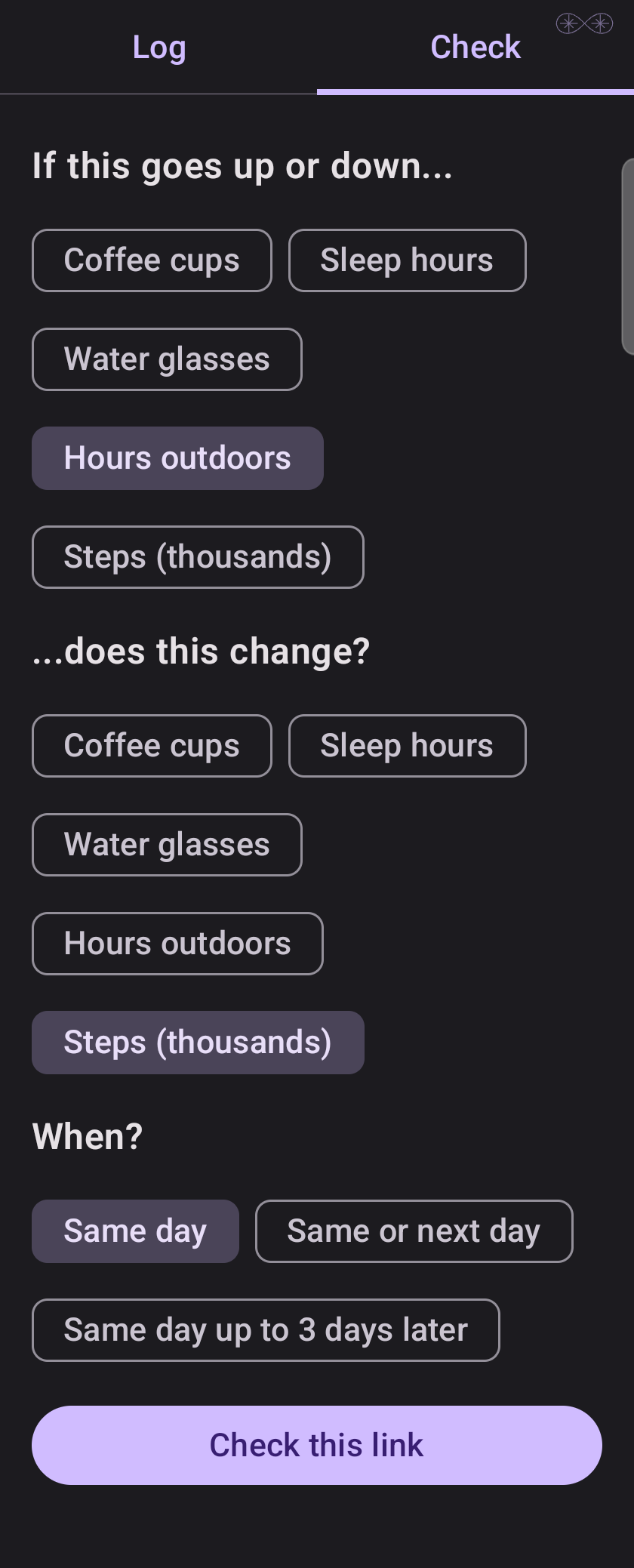
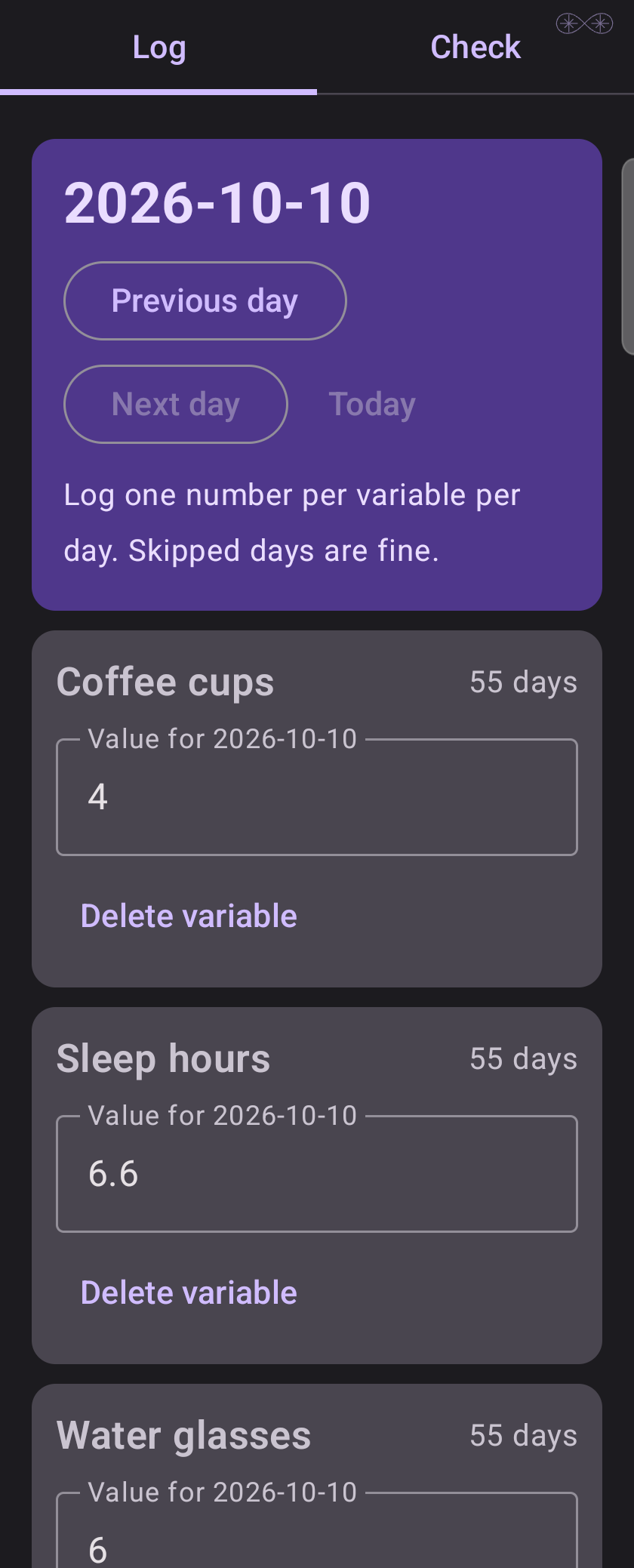
Did the coffee really cost you sleep? Do the headaches follow the weeks you skip breakfast? Log two or more numbers a day (or import a CSV) and HunchCheck gives a plain verdict with the reasons, instead of a correlation number that looks more convincing than it is.
Why a normal correlation calculator misleads you
Daily data is full of traps: Mondays differ from Saturdays, things drift over the months, and today's value depends on yesterday's. Two unrelated columns can look strongly linked just because they share a weekday pattern or a slow trend. HunchCheck removes the weekday pattern and the long-term trend, allows for day-to-day carryover, and then tests whether what is left could be chance.
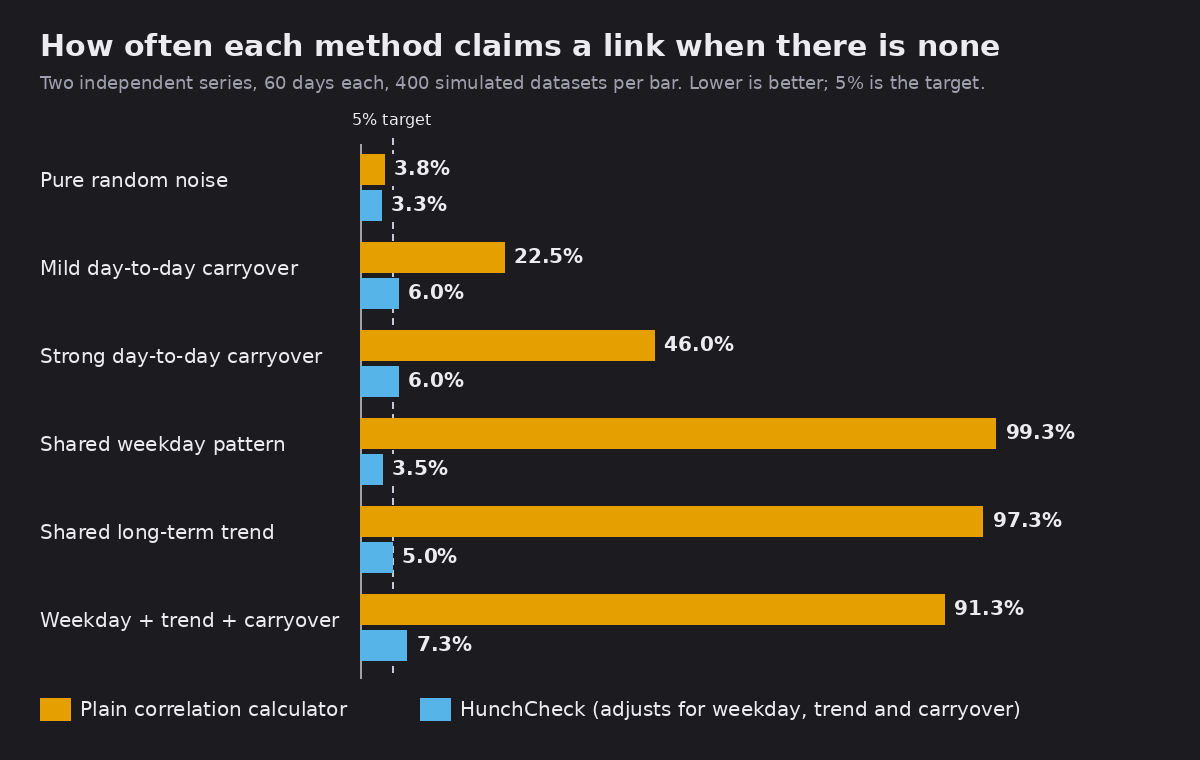
We measured it by simulation. With two unrelated series of 60 days each, 400 simulated datasets per case:
- Shared weekday pattern: a plain calculator claims a link 99% of the time; HunchCheck 3.5%
- Shared long-term trend: plain 97%; HunchCheck 5.0%
- Strong day-to-day carryover: plain 46%; HunchCheck 6.0%
- Over a larger 6,000-dataset run on three hard cases, HunchCheck's false-alarm rate was about 5% (measured 5.4%), which is what the 5% threshold promises
It also finds real links: a genuine link of moderate strength (r = 0.5) was found 95% of the time over 60 days. Weaker links need more days, and the app says "not enough data yet" instead of guessing.
What you get (full version)
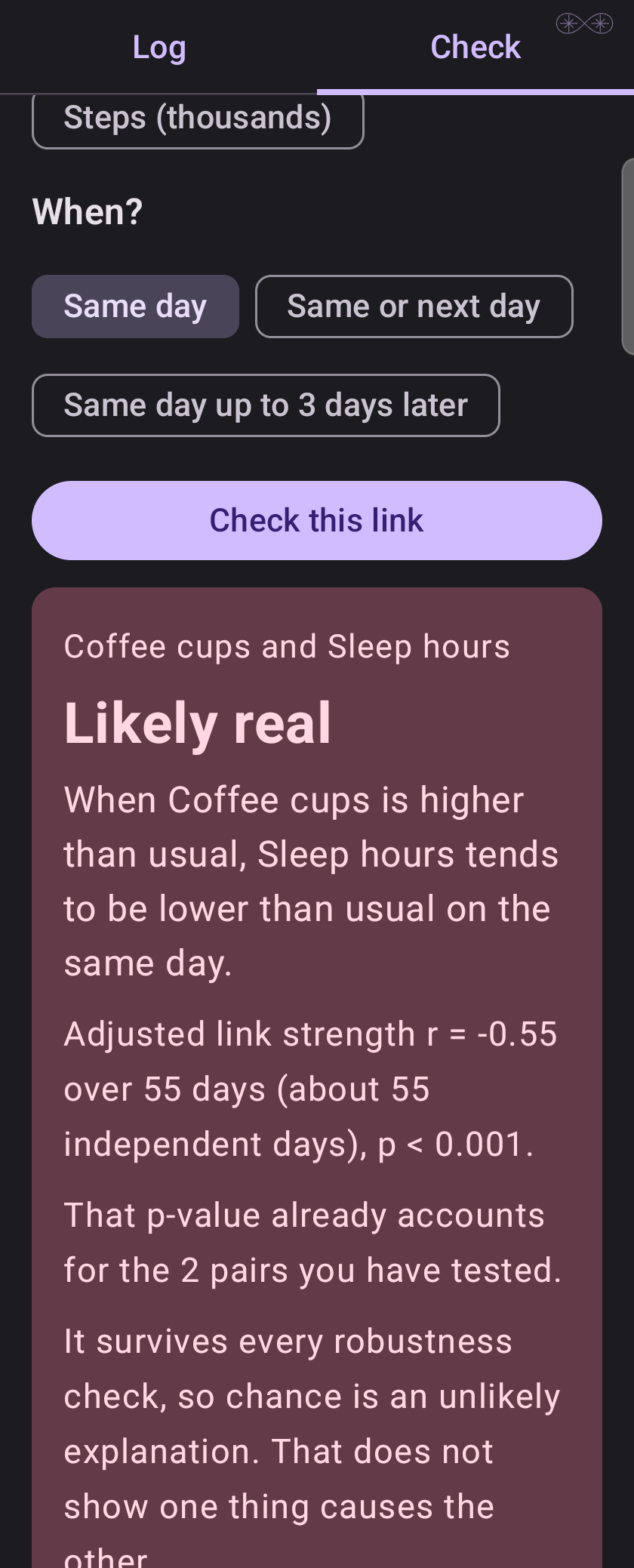
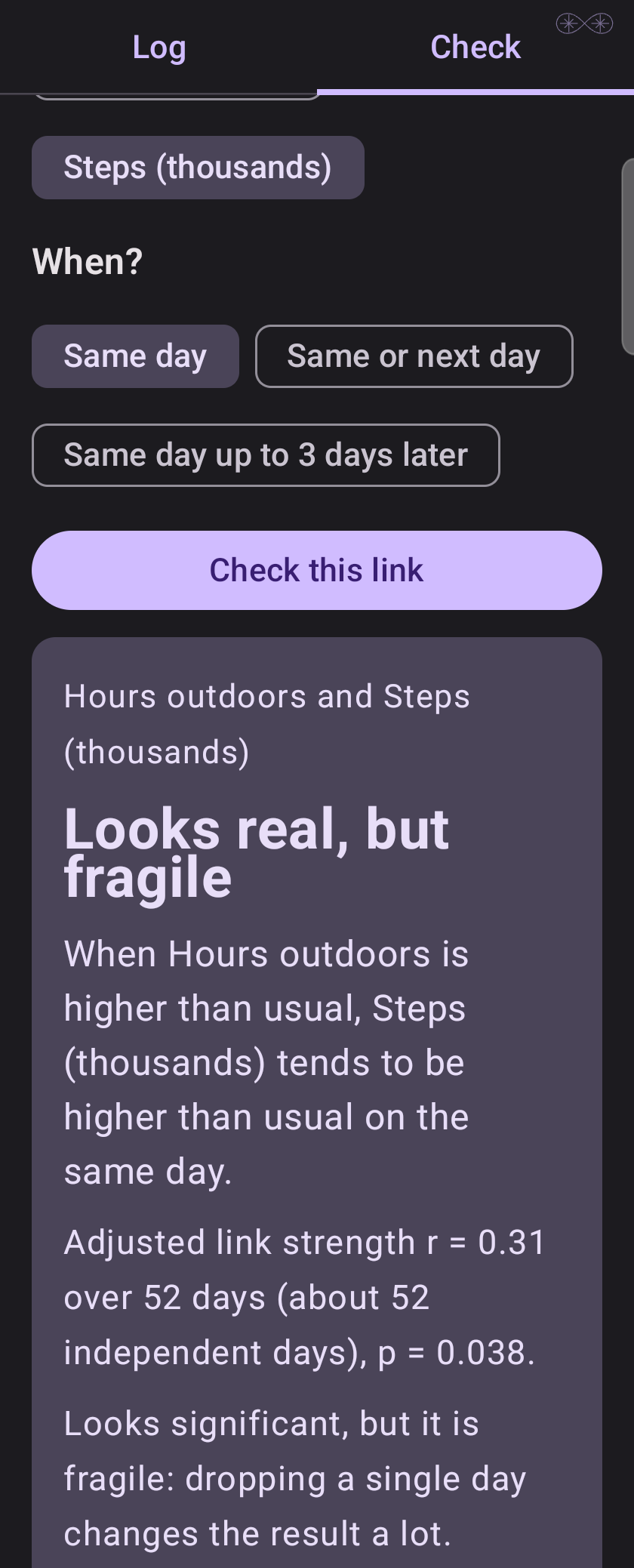
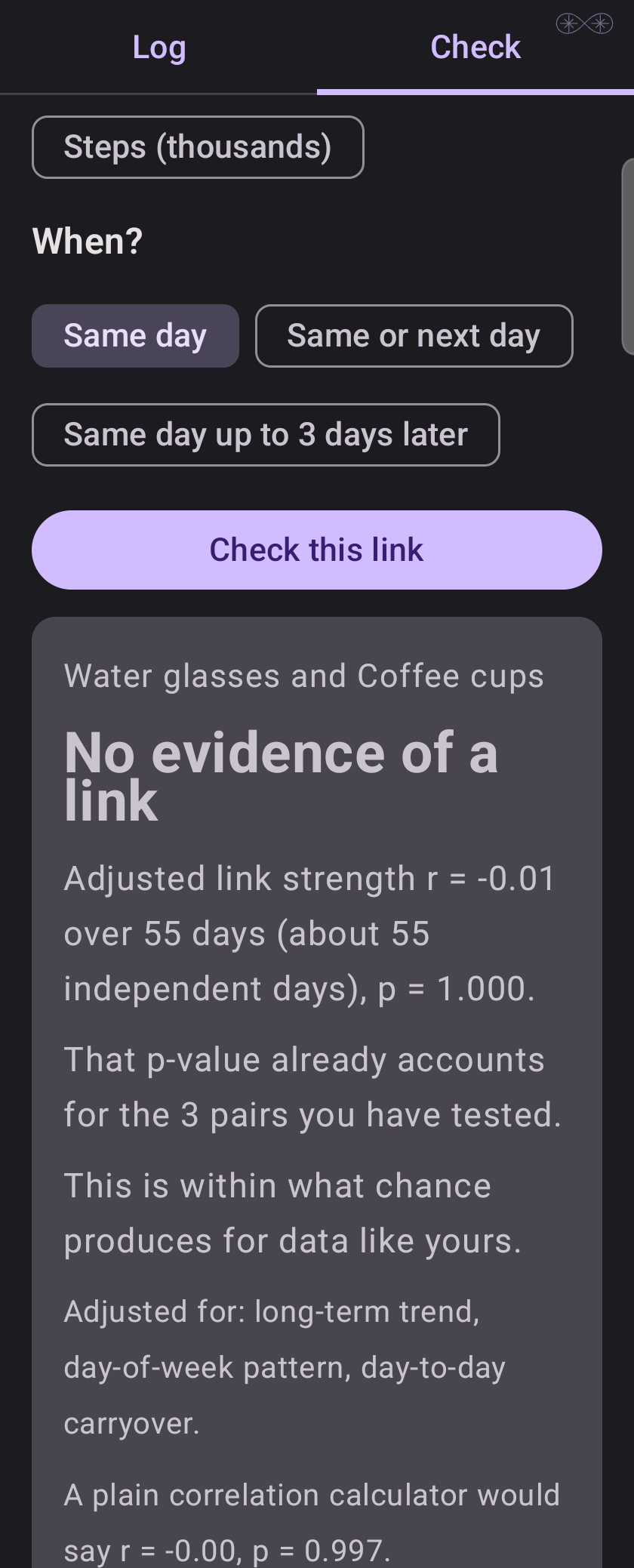
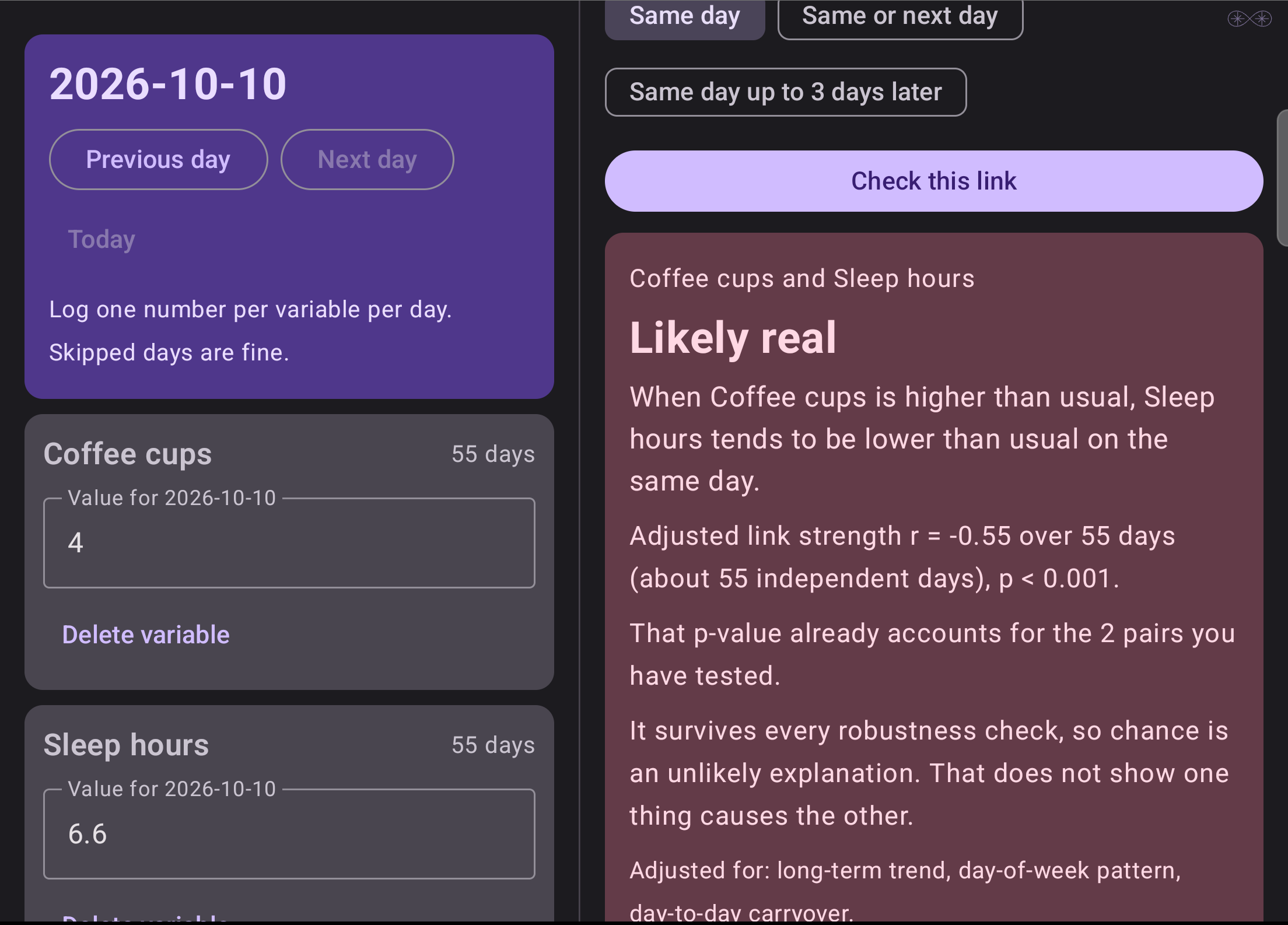
- Five honest verdicts: Likely real, Looks real but fragile, A hint (keep logging), No evidence of a link, Not enough data yet
- A "fragile" check that catches links created by one freak day, or that flip between the first and second half of your data
- Lag testing: does X affect Y the next day, or up to 3 days later? The result already accounts for scanning several lags
- A pairs-checked counter: every extra pair you test raises the bar, so fishing through many pairs cannot manufacture a result
- Side-by-side: what a plain correlation calculator would have said, so you can see what the adjustments changed
- Unlimited variables and days, CSV import, and a shareable text report
Private and simple
- Works fully offline: the app has no internet permission
- No ads, no account, no tracking, no subscription. Your numbers never leave your phone unless you share a report
- Skipped days are fine. Missing values are handled
- Adapts to phones, tablets and foldables (two-pane view on wide screens)
Free demo
The free demo works exactly like the full version for two variables and your latest 30 days, without CSV import or report sharing.
Good to know
- You need at least 21 days with both numbers logged. More is better, and two to three months is a good target.
- "Likely real" means chance is an unlikely explanation. It does not show that one thing causes the other.
- The adjustments assume weekday effects, a straight-line trend and simple day-to-day carryover. Patterns beyond that (for example seasons or illness spells) can still mislead any method.
- The accuracy figures above come from simulated data with those same properties, not from a clinical study.
- HunchCheck is personal data analysis, not medical advice. Talk to a professional about health decisions.
- Android 8.0 or newer. Install by downloading the APK and allowing installs from your browser or file manager when prompted.
- This app and its listing were created with the help of generative AI tools.
More from this studio
Purchase
In order to download this tool you must purchase it at or above the minimum price of $4.99 USD. You will get access to the following files:
Download demo